Sound business models in Forestry
Creating a successful tech company committed to nature-based solutions is challenging. Such a company must rely on three pillars:
- deep technology expertise (e.g., AI or drones)
- genuine commitment to sustainability
- a sound business model
After studying and conversing with many companies, I have concluded that, currently, you can only pick two out of these three pillars. I earnestly hope this situation changes soon and welcome further discussion if you believe otherwise. I am omitting specific company names to keep the discussion open.
Many tech-focused companies combining high tech with environmental service have privately acknowledged the particularly challenging financing conditions. The market for such companies remains relatively restricted, especially compared to adjacent domains like chatbots and assistants, which are absorbing most of the available capital. Investors expect significantly higher returns in a shorter time frame. Sustainability ventures typically require capital investments that take many years to mature, which is hard to accept for venture capital firms chasing the next Uber or Airbnb.
As a result, many companies rely on alternative funding sources, such as donations or governmental grants, instead of adhering strictly to market rules. However, a mission-based approach cannot replace a true product.
Indirect approaches to tackling climate change show promising early results. While these methods may not directly reduce emissions, they provide essential support to other initiatives that will eventually lead to emission reductions.
Insurance
Insurance companies must purchase carbon credits to offset their emissions. Forestry products pose a significant risk, particularly with the rapid pace of climate change. Factors like fires, droughts, and insects can quickly transform a forest into a carbon emitter. Insurance typically manages these risks, but companies have little interest in cash payouts. Cash does not cover potential fines or reputation damage for missing greenhouse gas (GHG) targets. Ultimately, they need to report carbon offsets. In-kind insurance addresses this issue by providing other carbon credits if a forestry asset suffers. This model, used by the Swiss startup CarbonPool, theoretically aligns incentives towards desired outcomes. Success hinges on the insurance company's ability to accurately predict forestry asset risks.
Risk Management
Forestry products often grow near housing and infrastructure. As trees grow, they may interact with infrastructure, potentially causing devastating fires, as seen in Hawaii and California in 2023. Utility companies have maintenance teams to trim trees around high-power lines, but these teams can only cover a small fraction of the network at any time. Companies like Overstory provide actionable insights, an elusive goal in the geospatial community.
Ecosystem Management
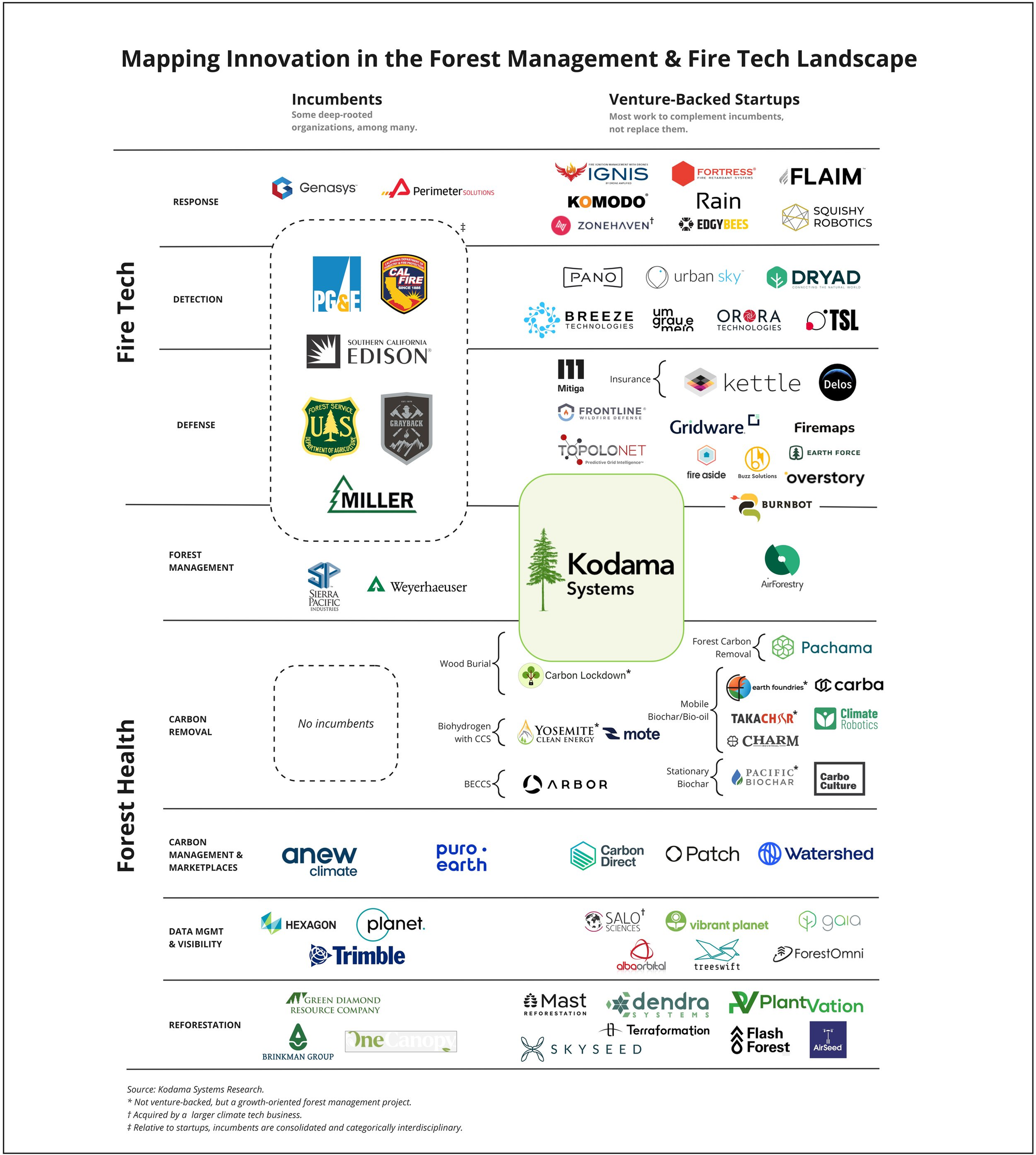
Tracking nature-based solutions is an emerging field. It involves the complete value chain, including intermediaries facilitating these solutions. The field is highly fragmented, and self-sustaining solutions are rare. This diagram and an excellent overview from Kodama illustrate the ecosystem's complexity.
This could change rapidly with the introduction of better standards and certifications in the forestry market. Most actors believe that the true cost of extracting a ton of carbon through nature-based solutions is around $30-$50, but it currently trades at $8. This gap reflects the lack of trust from the market, and I view new AI-based solutions critical in addressing this gap.